


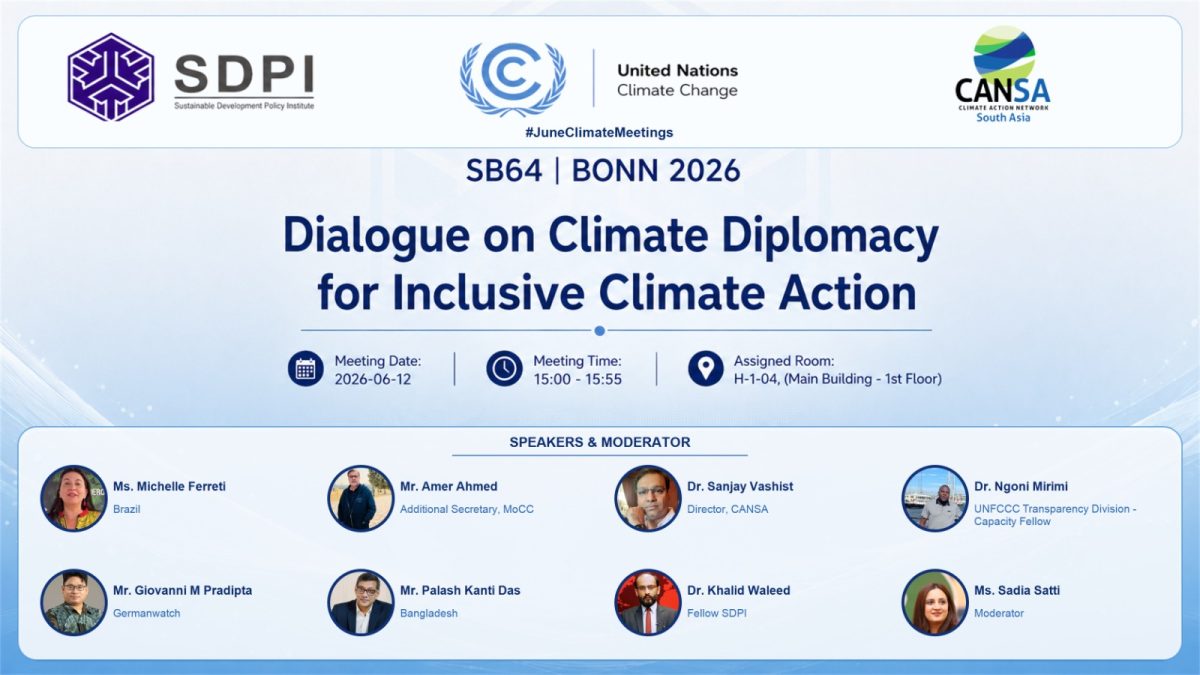
Date: 12th June 2026
Time: 15:00–15:55
Venue: H-1-04, Main Building, 1st Floor
Organisers: Sustainable Development Policy Institute (SDPI) and Climate Action Network South Asia (CANSA)
Climate change has moved from the margins of environmental policy to the centre of global diplomacy, development planning, economic stability, and human security. The increasing frequency of floods, heatwaves, droughts, glacial melt, sea-level rise, food insecurity, displacement, and livelihood losses has made climate action not only a technical responsibility but also a diplomatic, political, and ethical imperative. For climate-vulnerable developing countries, including Pakistan, Bangladesh, Brazil, and many others across the Global South, the challenge is no longer limited to raising ambition; it is equally about ensuring equity, access to finance, technology transfer, institutional capacity, and the inclusion of frontline communities in climate decision-making.
The UNFCCC process remains the principal multilateral platform for negotiating collective climate action. However, the complexity of climate governance requires engagement beyond formal negotiations. Climate diplomacy today must operate across multiple tracks. Track 1 diplomacy, led by governments, remains essential for formal negotiations, commitments, rules, finance arrangements, and implementation frameworks. Track 2 diplomacy, led by think tanks, civil society, academia, community organizations, youth, media, and the private sector, brings evidence, innovation, public legitimacy, and grounded perspectives from the frontlines of climate impacts. Track 1.5 diplomacy creates a bridge between these two spaces by enabling structured dialogue between government actors and non-state stakeholders in a less formal but policyrelevant setting.
This dialogue is designed to explore how these three diplomatic tracks can work together to advance inclusive climate action. Inclusive climate action means that climate policies, negotiations, finance mechanisms, and implementation pathways must reflect the voices and needs of vulnerable communities, women, youth, workers, local governments, indigenouspeoples, small producers, and climate-affected regions. It also requires that global climate commitments translate into nationally appropriate and locally beneficial outcomes.
The session will provide a platform for speakers from government, civil society, research institutions, international organizations, and climate advocacy networks to reflect on how climate diplomacy can become more responsive, participatory, and implementation-oriented. The discussion will particularly focus on how countries and institutions can strengthen the link between formal negotiations and local realities; how non-state actors can support trust-building, evidence generation, and accountability; and how Track 1.5 platforms can help convert climate ambition into practical partnerships, financeable projects, and inclusive outcomes.
The dialogue will also explore the role of South-South cooperation, regional learning, climate justice, adaptation finance, just transition, loss and damage, and locally led climate action. By bringing together diverse perspectives from Pakistan, Brazil, Bangladesh, civil society networks, and international research institutions, the session aims to contribute to a more practical
understanding of climate diplomacy as a delivery mechanism rather than merely a negotiation process.
Objectives :
The dialogue aims to highlight the importance of climate diplomacy in advancing inclusive climate action at global, national, and local levels. It will examine the complementary roles of Track 1, Track 2, and Track 1.5 diplomacy in strengthening climate governance, building trust, and connecting formal negotiations with communities and institutions responsible for implementation.
The session will also identify how developing countries and climate-vulnerable communities can be better represented in climate decision-making processes. It will encourage discussion on practical pathways for improving access to climate finance, strengthening partnerships, enhancing institutional coordination, and ensuring that climate action supports resilience, justice,
development, and social inclusion.
Key Themes:
The discussion will focus on climate diplomacy as a bridge between global ambition and national implementation; the role of formal intergovernmental negotiations in advancing equity, finance, adaptation, mitigation, and loss and damage; the contribution of civil society, think tanks, academia, and advocacy networks in shaping inclusive climate action; and the importance of Track 1.5 platforms in building trust between governments, experts, communities, and development partners.
The dialogue will also reflect on how climate-vulnerable countries can strengthen their collective voice, how local realities can inform global climate negotiations, and how climate diplomacy can support a just and inclusive transition in energy, agriculture, water, cities, and disaster risk management.
Expected Outcomes :
The session is expected to generate a shared understanding of how climate diplomacy can be made more inclusive, practical, and responsive to the needs of vulnerable countries and communities. It will help identify opportunities for stronger collaboration among governments, civil society, academia, development partners, and advocacy networks.
The discussion will also contribute to policy thinking on how Track 1, Track 2, and Track 1.5 climate diplomacy can be better aligned to support implementation, finance mobilization, trust-building, and community-centred climate action. The session will conclude with reflections on how inclusive climate diplomacy can strengthen global climate cooperation beyond SB64 and in the
lead-up to future COP processes.


