


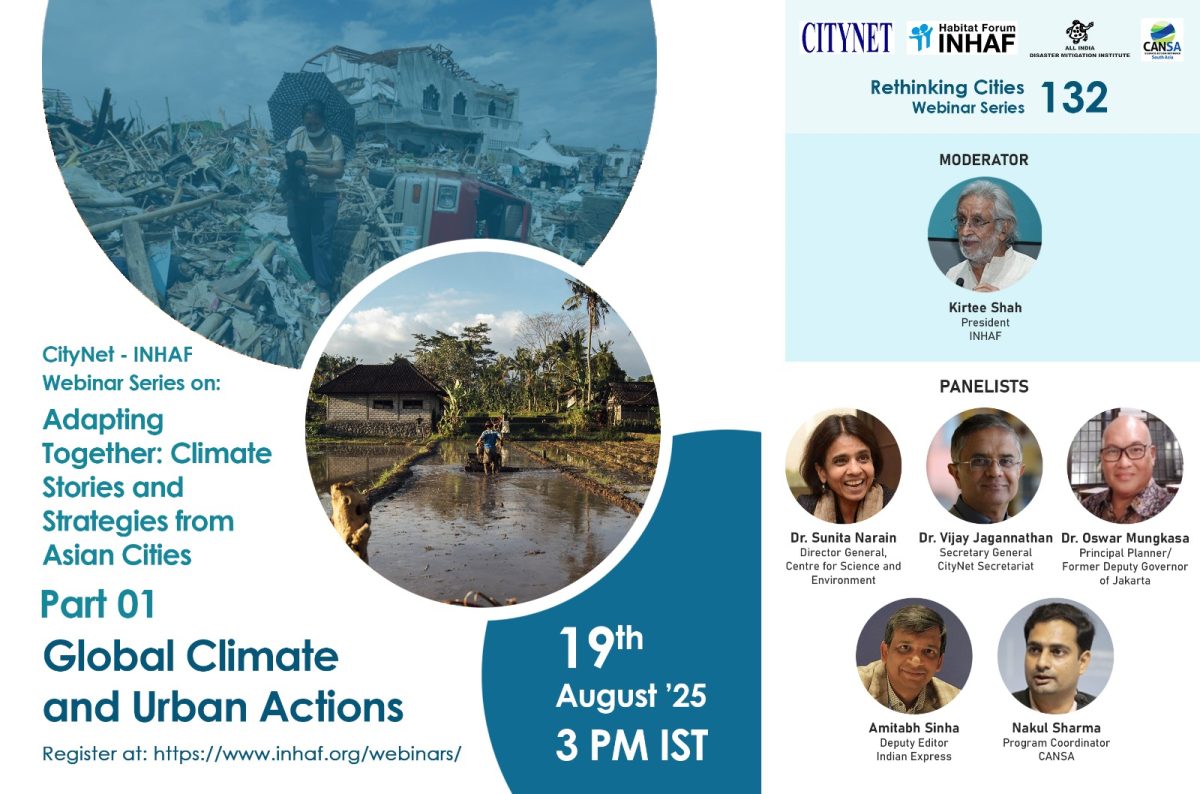
The opening webinar sets the tone for the entire five-part series. It seeks to situate urban climate action within global frameworks as well as Asian reality, and examine how international climate processes—particularly the Global Stocktake and COP negotiations—are shaping and being shaped by cities. A special focus will be placed on the evolving conversation around climate finance and how cities can access the resources needed to meet ambitious climate goals.
Cities are increasingly recognized as pivotal actors in the climate response, contributing over 70% of global CO₂ emissions while also being disproportionately affected by climate impacts. From extreme heat in Delhi to sea-level rise in Jakarta, cities across Asia are grappling with intensifying risks. Yet they are also incubators of innovation, policy leadership, and community-based adaptation. However, without access to adequate and sustained finance, many city-level initiatives remain under-resourced and fragmented.
This session invites thought leaders, practitioners, and researchers to reflect on how global climate policy, particularly through the COPs, intersects with city-scale action, and how urban voices and financing needs can be better integrated into global governance.
The GST is a key component of the Paris Agreement, assessing collective progress toward limiting global warming to 1.5°C. While it primarily addresses national contributions (NDCs), its first iteration, concluded at COP28, acknowledged the essential role of local governments and non-state actors.
While COP decisions remain mostly nationally focused, recent COPs have produced declarations acknowledging the urban scale:
While COP decisions remain mostly nationally focused, recent COPs have produced declarations acknowledging the urban scale:
Chennai’s Resilient City Plan addresses both emissions and vulnerability.
Ahmedabad’s Heat Action Plan is often cited globally as a best practice in climate-health alignment.


