


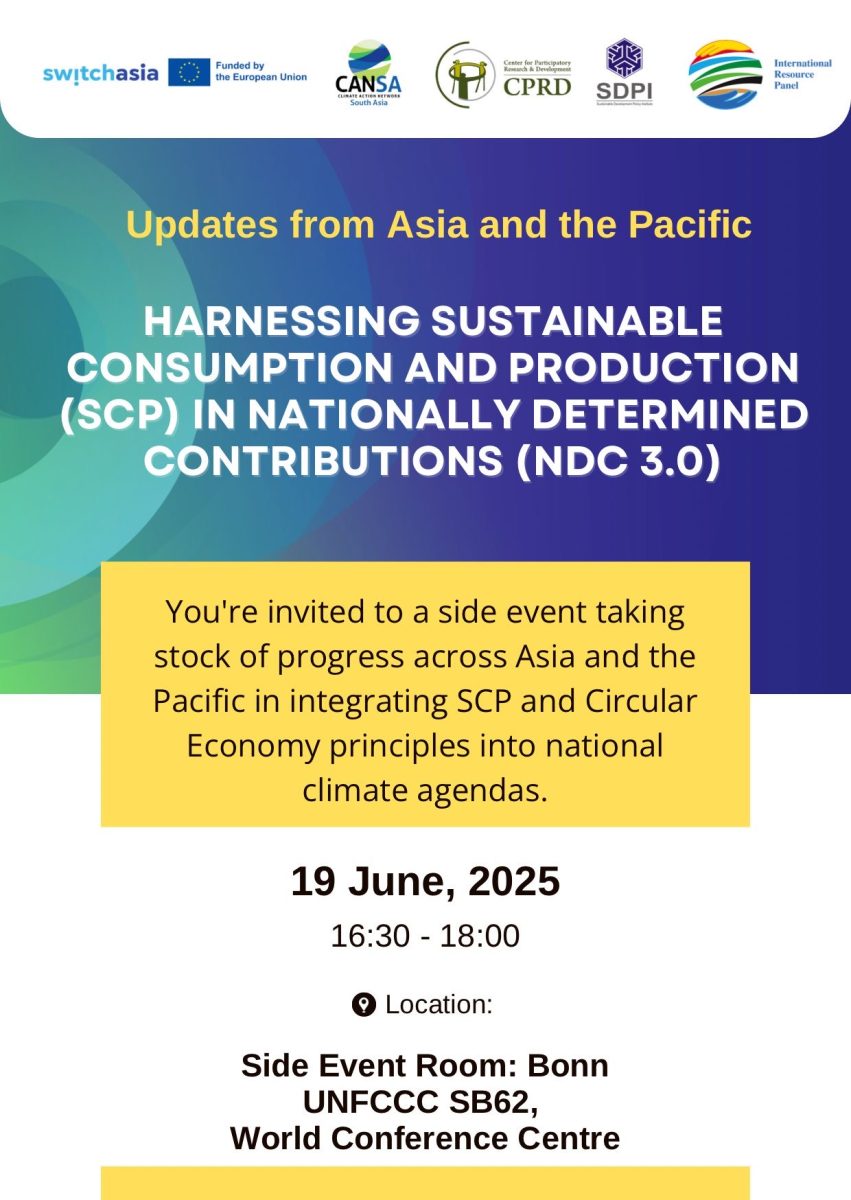
Date: 19 June 2025
Venue: Side Event Room Bonn, UNFCCC SB62 Venue, World Conference Centre, Bonn
Time: 16:30 to 18:00
SWITCH-Asia, Climate Action Network South Asia (CANSA), EU SWITCH-Asia Programme, Centre for Participatory
Research and
Development (CPRD), Sustainable Development Policy Institute (SDPI)
The year 2025 marks a defining moment in the global climate landscape, with countries expected to submit their enhanced Nationally Determined Contributions (NDC 3.0) ahead of COP30 in Belem, Brazil. Beyond ambition, the core challenge lies in implementation and monitoring, ensuring that commitments translate into meaningful climate action.
Sustainable Consumption and Production (SCP) and Circular Economy (CE) present innovative pathways to align socioeconomic development with climate mitigation. These strategies enable resource-efficient growth, reduce emissions, and bolster climate resilience while engaging the private sector and supporting national development priorities.
The findings of the Global Resource Outlook 2024, published by the International Resource Panel (IRP), reinforce this by showing that resource extraction and processing contribute to over 60% of global greenhouse gas emissions and 90% of land-use releated biodiversity loss and water stress. There are significant disparities between countries as high-income countries consume six times more materials per capita than low-income countries. These disparities highlight the urgent need for transformative policy action to achieve more equitable and sustainable resource management. The report underscores that material efficiency and circularity strategies alone could reduce global greenhouse gas emissions from materials production by up to 40% by 2060,
The IPCC’s Sixth Assessment Report and the UNEP Emissions Gap Report 2024 both call for drastic reductions in emissions to maintain a pathway to 1.5°C warming. Specifically, greenhouse gas emissions must be cut by 42% by 2030 and 57% by 2035. Without immediate and systemic changes, the world risks warming between 2.6–3.1°C this century—a scenario with severe consequences for people, ecosystems, and economies. —highlighting
The Global Stocktake (GST) concluded at COP29 in Baku underlined the need for increased ambition, enhanced action, and international support. The GST further emphasized the importance of net-zero transitions tailored to each country’s context, requiring whole-of-government approaches, robust financial architecture reform, and enhanced private sector participation. SCP and CE offer avenues for such systemic transitions, enabling countries to enhance climate ambition while advancing sustainable development.
To fully harness the climate mitigation and adaptation potential of Circular Economy, Material Resource Efficiency, and SCP, these approaches must be strategically integrated into national climate ambitions. Climate change cannot be addressed in isolation; it is intrinsically linked with the broader environmental and natural resource use and managements context, particularly biodiversity loss and pollution. By embedding SCP and CE into climate policy frameworks, countries can tackle the triple planetary crisis in a cohesive and transformative way—maximizing climate benefits while advancing sustainable development and ecological integrity.
The EU SWITCH-Asia Programme, in collaboration with CANSA, CPRD, and SDPI, is convening this side event to take stock of progress made across Asia and the Pacific in integrating SCP and CE principles into national climate agendas. The SB62 session in Bonn represents a critical juncture in the global climate negotiation calendar, offering a timely opportunity to discuss how SCP and CE can support Just Energy Transitions and the Mitigation Work Programme.
| Time | Session | Speaker | |
|---|---|---|---|
| 16:30 – 16:35 | Welcome Remarks | Sanjay Vashist, Senior Expert, EU SWITCH-Asia Programme | |
| 16:35 – 16:40 | Background & Introduction | Ranga Pallawala, Expert on Climate Change, SWITCH-Asia PSC | |
| 16:40 – 16:55 | Technical Presentation – Why Circular Economy… | Rene Van Berkel – Senior Expert Circular Economy, Panel Member – International Resources Panel (IRP) | |
| 16:55 – 17:10 | Panel Discussion Moderated Panel Discussion Moderated by Dilovarsho Dustzoda, Senior Expert, EU SWITCH-Asia |
Moderated Panel Discussion Moderated by Dilovarsho Dustzoda, Senior Expert, EU SWITCH-Asia
|
|
| 17:50 – 18:00 | Wrap up & Vote of Thanks | Ms. Tenzin Wangmo, Expert, EU SWITCH-Asia Programme |
SWITCH-Asia
The SWITCH-Asia Policy Support Component (PSC) aims to advance Sustainable Consumption and Production (SCP) by integrating and amplifying SCP policies across 42 countries spanning the Middle East, Central Asia, South Asia, Southeast Asia, and the Pacific. Built on the strong foundation of the broader SWITCH-Asia Programme, the PSC delivers flexible, demand-driven technical assistance and creates synergies with grant components and EU Delegations. Its objective is to drive cooperation, enable knowledge exchange, and support countries in addressing the triple planetary crises. The programme supports the implementation of the 2030 Agenda and the Paris Agreement.
Climate Action Network South Asia (CANSA)
Climate Action Network South Asia (CANSA) is a coalition of over 250 civil society organizations across eight South Asian countries, advocating for government and grassroots action to combat human-induced climate change. CANSA promotes equity, social justice, and sustainable development while safeguarding the global environment. The network is a strong voice in international climate negotiations and bridges policy, research, and grassroots initiatives to address climate vulnerabilities and promote workable, locally-rooted solutions.
Sustainable Development Policy Institute (SDPI), Pakistan
SDPI is a leading policy research think tank based in Islamabad, Pakistan, dedicated to catalyzing sustainable development in the region. Through evidence-based research, policy analysis, and stakeholder engagement, SDPI works on climate change, environmental governance, green economy, and social equity. The institute supports government and civil society actors in formulating and implementing strategies that address multidimensional sustainability challenges.
Centre for Participatory Research and Development (CPRD), Bangladesh
CPRD is a Dhaka-based non-governmental research and advocacy organization focused on promoting climate justice and environmental sustainability. It engages in participatory policy research, grassroots mobilization, and regional advocacy to strengthen climate resilience, especially among vulnerable communities. CPRD is known for amplifying the voices of climate-affected populations in national and global policy dialogues


