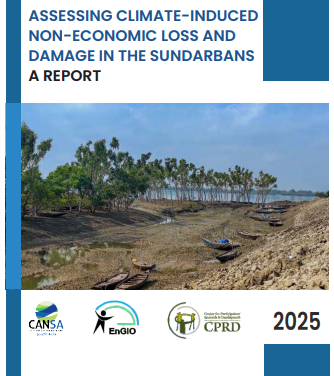
The Sundarbans, the world’s largest mangrove delta shared by India and Bangladesh is a landscape of breathtaking resilience and deep vulnerability. Here, the rising tides of climate change do not only wash away homes and fields; they erode identities, memories, and ways of life.
While much attention is given to the economic costs of climate disasters, an equally profound story remains untold that of non-economic loss and damage (NELD). These are the losses that cannot be measured in money: the disappearance of sacred spaces like the Bonbibi shrines, the trauma carried by tiger widows, the displacement of families and cultures, the disruption of education, and the quiet fear that shadows every new cyclone season.
Through this joint study, Climate Action Network South Asia (CANSA), Centre for Participatory Research and Development (CPRD, Bangladesh), and EnGIO (India) bring together lived experiences from both sides of the delta to show how climate change is reshaping not just livelihoods but lives
The findings call for urgent recognition of non-economic losses within climate policy and finance frameworks, and for people-centered adaptation that preserves dignity, culture, and hope.
Because in the Sundarbans, loss is not just about what can be rebuilt it’s about what can never be replaced.