


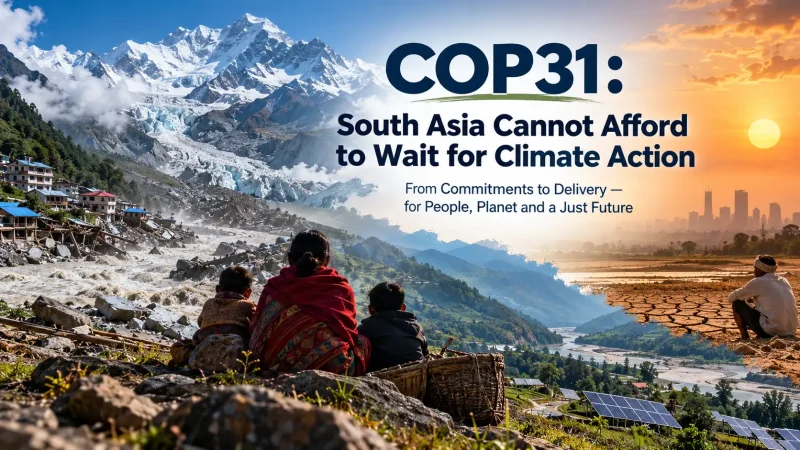
The recent cryosphere-linked disasters in the Himalayas are a stark reminder that climate change is no longer a distant threat. In August 2026, a devastating rock-and-ice collapse and debris-laden flooding in the Gyirong–Rasuwa border corridor between China and Nepal demonstrated how rapidly changing mountain conditions can trigger cascading disasters across borders. For South Asia, where millions depend on climate-sensitive agriculture, fragile mountain ecosystems, glacial water systems and vulnerable coastlines, the consequences are profound.
These disasters do not occur in isolation. They threaten water security, food production, public health, livelihoods and infrastructure. They can displace communities, deepen inequality and intensify competition over already scarce resources. The impacts are interconnected, often crossing national boundaries, and demand regional cooperation, shared early-warning systems and people-centred approaches to resilience.
Yet the world continues to fall short of the action required to address the climate crisis.
UNEP’s Emissions Gap Report 2026: The Point of Return makes the challenge unmistakably clear. Under current policies, #GlobalWarming could reach 2.8°C during this century. Even if countries fully implement their existing national climate commitments, warming is projected to reach approximately 2.6°C. The report warns that global temperatures are now expected to exceed 1.5°C above pre-industrial levels, although urgent and deep emissions cuts could still limit the extent and duration of this overshoot and bring temperatures back to 1.5°C by 2100.
To follow the report’s lowest-possible overshoot pathway, global greenhouse gas emissions must fall by 18 per cent by 2030, 45 per cent by 2035 and 69 per cent by 2040, relative to 2025 levels.
The question we must ask is simple: how are poor and vulnerable communities expected to prepare for a world approaching 2.8°C of warming when many are already struggling to cope with the impacts of climate change today?
Adaptation finance must respond to people’s needs
For South Asia, adaptation is not an optional addition to #ClimateAction. It is an immediate necessity. Farmers are confronting increasingly unpredictable rainfall and heat stress. Mountain communities face floods, landslides and changing snow and glacier dynamics. Coastal populations face rising seas, erosion and intensifying storms. Urban communities are exposed to extreme heat, water shortages and flooding.
These communities cannot wait for global emissions to decline before receiving the resources they need to protect their lives and livelihoods.
At COP30 in Belém, countries called for adaptation finance to be tripled by 2035. #COP31 must go beyond reiterating this commitment and establish a credible pathway for delivering it, with clear milestones, accountability and accessible, grant-based finance.
Adaptation finance must be needs-based, not driven by what is easiest to fund or what institutions find easiest to measure. It must reflect the differing vulnerabilities, capacities and priorities of countries and communities, including least developed countries, Indigenous Peoples, women, smallholder farmers, informal workers and people living in climate hotspots. Funding should support locally identified priorities, from water security and climate-resilient agriculture to heat action plans, disaster preparedness, resilient infrastructure and ecosystem restoration.
Crucially, access must be simplified so that finance reaches local governments, community organisations and frontline communities directly, with appropriate safeguards and accountability. Communities should not have to navigate prohibitive procedures or depend entirely on intermediaries to access the resources required to protect their futures.
COP31 should be judged in part by whether it unlocks adaptation finance that reaches the people who need it most—not simply by the amounts pledged or the number of funding mechanisms announced.
For South Asia, adaptation must also include stronger regional cooperation. Climate hazards in the Hindu Kush Himalaya cannot be addressed through isolated national responses alone. Shared scientific monitoring, cross-border data exchange, early-warning systems and anticipatory action can help reduce the loss of lives and livelihoods. These efforts must complement, not replace, the international finance obligations of developed countries.
Mitigation ambition must translate into action now
There is no time to postpone emissions reductions while waiting for another round of commitments. Every year of delay locks in additional warming, increases the scale of future adaptation needs and raises the risk of irreversible damage.
The Emissions Gap Report calls for emissions reductions on a scale that existing national commitments do not yet deliver. Developed countries, given their historical responsibility and greater capacity, must lead with deep, rapid and sustained emissions cuts, while providing finance and technology to enable developing countries to pursue equitable low-carbon development.
The decisions taken at COP28 in Dubai called for transitioning away from fossil fuels in energy systems, alongside accelerating #RenewableEnergy and energy efficiency. COP31 must advance implementation of these commitments, with clear pathways and support for a just and equitable transition.
The principle is straightforward: we cannot keep asking for greater ambition while failing to demonstrate delivery on the commitments already made. Raising ambition and implementing existing commitments are not competing priorities. They must proceed together, with measurable progress now.
Just transition must transform economies and benefit society
A just transition cannot be reduced to changing one energy source for another. While the transition away from fossil fuels is essential, a genuinely just transition must also transform the ways we produce, consume, use resources and organise our economies. It must change practices, not merely energy regimes.
For South Asia, this means placing the circular economy at the heart of the transition. Reducing waste, extending product lifespans, repairing and reusing goods, improving recycling, designing out pollution and creating resource-efficient production systems can reduce emissions and pressure on natural resources while generating livelihoods and strengthening local economies. These approaches can create opportunities for small enterprises, waste workers, repair businesses, local innovators and communities—provided that workers are protected, decent work is promoted and the benefits are shared fairly.
Circularity must therefore be recognised as an integral part of just transition planning, alongside clean energy, social protection, skills development and economic diversification. It can deliver multiple societal benefits: lower resource consumption, reduced pollution, new livelihood opportunities, more resilient local economies and greater community participation in sustainable development.
The Belém Action Mechanism for Just Transition offers an opportunity to strengthen international cooperation and support countries in pursuing transitions that are equitable and inclusive. COP31 must advance its operationalisation and ensure that the institutional process is built to drive sustained action on just transition—not established with fanfare only to be weakened, sidelined or dismantled in subsequent years.
This requires a durable institutional mandate, meaningful participation by workers and affected communities, adequate resources, and a process that can support implementation over time. A just transition must not become another temporary initiative without the means to deliver.
For South Asia, the test is whether the transition improves people’s lives: whether it creates decent work, protects vulnerable livelihoods, reduces inequalities and delivers tangible environmental and social benefits. A transition that changes the energy system but leaves existing patterns of exclusion and resource exploitation untouched will not be sufficient.
Loss and damage: a fund must mean funding
The establishment and operationalisation of the Fund for Responding to #LossAndDamage at COP28 in Dubai was an important achievement. Campaign Hub’s Fill the Fund campaign, of which CAN International and #CANSA are part of the steering committee, has consistently called for the fund to receive resources commensurate with the scale of the crisis.
But establishing a fund is only the beginning. Communities that have lost homes, farmland, infrastructure, cultural heritage and sources of income need support that is timely, adequate and accessible. Climate-related losses are not limited to what can be measured in financial terms. They include the loss of ancestral lands, ecosystems, traditions and ways of life.
At COP31, governments must strengthen the fund through substantial new contributions, predictable replenishment and grant-based, non-debt-creating finance. The Santiago Network and the Warsaw International Mechanism must also be supported in their work to address loss and damage, including through technical assistance and stronger understanding of economic and non-economic losses.
For countries already struggling with debt and competing development needs, climate disasters must not create another cycle of borrowing simply to recover from damage they did little to cause.
COP31 must deliver, not defer
The challenge before COP31 is not a lack of evidence or a shortage of commitments. It is the persistent gap between what science demands, what governments promise and what reaches people on the ground.
South Asia needs COP31 to deliver a credible pathway for tripling adaptation finance, with funding allocated according to need and made directly accessible to vulnerable communities. It needs substantial new contributions to the Loss and Damage Fund, accelerated emissions reductions and a just transition that transforms production and consumption practices, places circularity at its heart and delivers benefits across society. It also needs durable institutions that can sustain this work beyond a single conference or political cycle.
COP31 should be judged not by the number of declarations adopted, but by whether finance reaches vulnerable people, whether emissions begin to fall at the pace required by science, and whether the transition creates fairer, more resilient and resource-efficient societies.The world cannot afford to wait for ambition tomorrow. The people on the frontlines need action today—and a transition that leaves no one behind.
By Dr Sanjay Vashist, Director, Climate Action Network South Asia (CANSA)


