


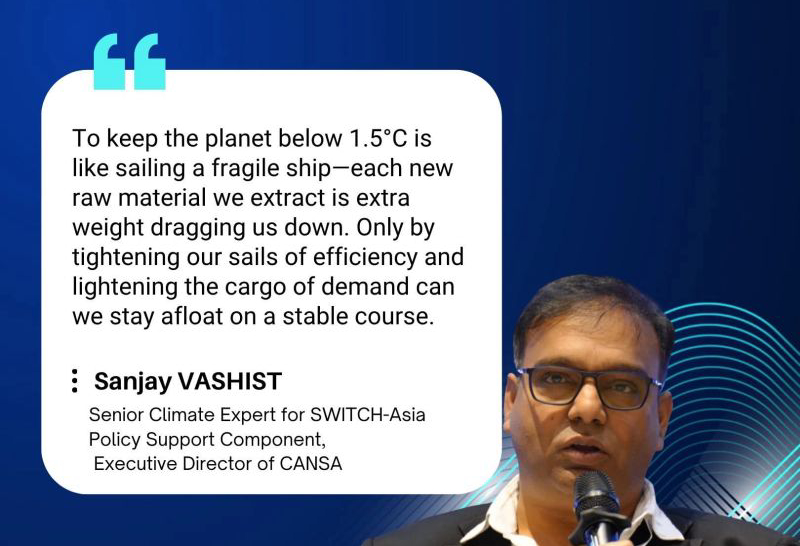

As we stand amidst the urgent realities of climate change, it’s increasingly clear that our existing pathways are insufficient. The latest reports remind us that we remain far from meeting the Paris Agreement’s critical goal of limiting global warming to 1.5°C. The UN Secretary-General recently issued a stark warning: “Overshooting is now inevitable.” This means higher, more destructive heat levels are not just possible—they are becoming our reality, with unpredictable impacts on communities worldwide.
The sobering truth is that current national pledges fall dramatically short. Even if all promised cuts are met, science tells us we are still on a trajectory to overshoot. To turn the tide, we need to embed deeper, broader, and more systemic changes into our climate strategies—changes that go beyond swapping #FossilFuels for renewables. One vital, yet often overlooked, frontier for climate #Mitigation and #Adaptation is rooted in the materials that build our world.
Why Material Use Matters in Climate Action
For too long, climate policy has fixated on energy—on cleaning up power grids and phasing out coal. While essential, this focus overlooks a major source of emissions: material extraction and use. According to the International Resource Panel, as much as 60% of the potential emissions reductions lie in making resource use more efficient and managing extraction cycles better. Every brick laid, every cellphone produced, every piece of packaging materials embodies a carbon footprint that’s often taken for granted.
Recognizing this, we must shift our narratives from ‘cure’ to ‘growth tonic’—from reactive measures to proactive, sustainable development. Enter the circular economy, a transformative approach that promises to fuel faster, sustainable growth while delivering climate co-benefits at multiple levels.
Circular Economy: More Than Just Recycling—A Nexus for Growth and Climate Resilience
The circular economy isn’t a cure-all overnight remedy—it’s a vital “health tonic” for our global system. It nurtures a paradigm shift: turning resource efficiency from a check-box into a strategic growth driver. When we lessen demand for raw materials—like metals, cement, plastics—we simultaneously cut emissions, create jobs, and free fiscal space for social welfare and climate resilience initiatives.
And the momentum is undeniable. The Asia-Pacific market alone is projected to grow at an impressive 11.4% CAGR, from USD 149.86 billion in 2024 to USD 355.44 billion by 2032. This surge demonstrates regional consensus on scaling up circular business models. Countries like India, Bangladesh, Sri Lanka, and Pakistan are embracing innovative practices—from waste recycling to resource-efficient manufacturing—that directly cut greenhouse gases while fostering economic diversification.
Efficiency as a Catalyst for Broader Benefits
Resource efficiency unlocks multiple benefits beyond simple emission cuts:
High-Potential Sectors for South Asia’s Circular Transition
Transforming South Asia’s economy—home to over a billion consumers and industries with significant emissions—is critical. Key sectors where circular economy practices could make the biggest impact include:
If these system-level investments are unlocked, the potential is transformative: by 2050, circular economy solutions could decrease natural resource consumption by 19%, improve resource efficiency by 12%, and cut greenhouse gas emissions by 17%.
The Road Ahead at COP30
As the world gathers at #COP30, the message must be clear: the climate crisis demands innovative, integrated solutions grounded in justice and sustainability. The circular economy offers a pathway—an engine for growth that aligns with climate goals and social equity. It champions a transition that’s not just about avoiding catastrophe but about creating a resilient, inclusive future.
The need for bold action is urgent. But within that urgency lies opportunity—a chance to rethink how we produce, consume, and build our economies. Let COP30 be a turning point, where commitments are not only reinforced but expanded into real, comprehensive strategies that embed the #ClimateMaterialNexus at their core.
Because in this transition, justice lies in recognizing that our future hinges on how effectively we manage our materials—how resourceful, circular, and #Resilient we become. The time is now to embrace a growth paradigm that benefits people and the planet alike.
By Dr. Sanjay Vashist, Director, Climate Action Network South Asia (CANSA)


