ActionAid, the Asia Disaster Risk Reduction Network (ADRRN) and Climate Action Network South Asia (CANSA) with the support of the Asia-Pacific Network for Global Change Research (APN) have jointly produced the Handbook for Community-Led Assessment of Climate-Induced Loss and Damage.
Download Here PDF The Bangladesh Environment and Development Society (BEDS) recently published an outcome document titled Disaster Ready Community in the Sundarbans.
Download Here This training manual has been developed by Peepal Foundation for trainers and trainees of the government officials and CSOs to make them capable of formulating children- and women-responsiveDRR and climate-resilient policies and integrated planning. Peepal Foundation would like to recognizethe contributions of CANSA, THANAL, Oxfam India, and GEAG, and in particular Shailendra Yashwant,Anoop […]
Download Here This WASH Climate Change Adaptation Training Module is developed as part of an initiative to build capacity of state level government officials in India by explaining the linkages between WASH and climate change adaptation, subsequently to reduce their states’ vulnerability to climate change. It presents selected tools and methods that they can use […]
Download Here This training manual has been developed by GEAG for trainers and trainees of the government officials and CSOs to make them capable of formulating children and women responsive DRR and climate resilient policies and integrated planning. GEAG would like to recognize the contribution CAN South Asia, THANAL and Oxfam India for their consistent […]
By Rushati Das
At the COP19 in Warsaw, Poland, Warsaw International Mechanism (WIM) for Loss and Damage associated with Climate Change Impacts (Loss and Damage Mechanism) was established under the Cancun Adaptation Framework.
Download Here As global emissions from burning carbon-intensive fuels, deforestation, industrial agriculture et al continue to exhaust the greenhouse gas (GHG) emissions budget for 1.5ºC (the global temperature increase goal aspired to be achieved under Paris Agreement), there is an exponential increase in the vulnerability of India. Reports2 indicate that India is one of the most vulnerable […]
Download Here District level planning is currently carried out through coordination between District Planning Committee (DPC), Zila Panchayat accumulating Gram Panchayat Development Plans (GPDP) and Municipalities in urban areas. The DPC is mandated to develop a holistic plan for Panchayats and Municipalities including spatial planning, water and other physical/natural resources, integrated infrastructure, and environmental conservation. […]
By Senashia Ekanayake
The world we live in is fast depleting and dying in front of our eyes. 15-year olds take centre stage while 70+ year olds gamble their remaining
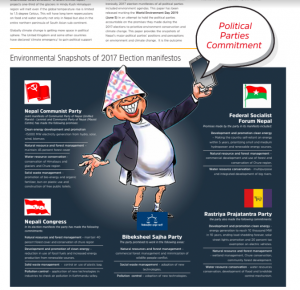
In the election manifestos, political parties had made commitments to develop and promote clean energy, properly manage natural resources and forest, conserve water resources, control pollution and manage solid waste. A joint manifesto of Communist Party of Nepal (Unified Marxist-Leninist) and Communist Party of Nepal (Maoist Centre) promised to generate 15,000 MW electricity generation from hydro, solar and other renewable energy sources and conservation of Himalayan glaciers.