The Paris Agreement envisages NDCs actions incrementally to build resilience and raise ambitions to address climate impacts across the globe. Consistent local implementation of NDCs is crucial to fill the large gap between the climate targets and the fair share of the Parties. However, the COVID-19 pandemic shifted the global and national focus away from […]
Of all the states in the country, Kerala has to be particularly vigilant against the potential harmful impacts of climate change. Yet, there have been excellent initiatives, some of them were facilitated by NGOs like Thanal and some of them pushed with far-sight by public agencies like KSEBL, ANERT, Cochin International Airport and […]

This training manual has been developed by Peepal Foundation for trainers and trainees of the government officials and CSOs to make them capable of formulating children- and women-responsiveDRR and climate-resilient policies and integrated planning. Peepal Foundation would like to recognizethe contributions of CANSA, THANAL, Oxfam India, and GEAG, and in particular Shailendra Yashwant,Anoop […]

This WASH Climate Change Adaptation Training Module is developed as part of an initiative to build capacity of state level government officials in India by explaining the linkages between WASH and climate change adaptation, subsequently to reduce their states’ vulnerability to climate change. It presents selected tools and methods that they can use […]
This training manual has been developed by GEAG for trainers and trainees of the government officials and CSOs to make them capable of formulating children and women responsive DRR and climate resilient policies and integrated planning. GEAG would like to recognize the contribution CAN South Asia, THANAL and Oxfam India for their consistent […]
As global emissions from burning carbon-intensive fuels, deforestation, industrial agriculture et al continue to exhaust the greenhouse gas (GHG) emissions budget for 1.5ºC (the global temperature increase goal aspired to be achieved under Paris Agreement), there is an exponential increase in the vulnerability of India. Reports2 indicate that India is one of the most vulnerable […]

District level planning is currently carried out through coordination between District Planning Committee (DPC), Zila Panchayat accumulating Gram Panchayat Development Plans (GPDP) and Municipalities in urban areas. The DPC is mandated to develop a holistic plan for Panchayats and Municipalities including spatial planning, water and other physical/natural resources, integrated infrastructure, and environmental conservation. […]
election manifestos, political parties had made commitments to develop and promote clean energy, properly manage natural resources and forest, conserve water resources, control pollution and manage solid waste. A joint manifesto of Communist Party of Nepal (Unified Marxist-Leninist) and Communist Party of Nepal (Maoist Centre) promised to generate 15,000 MW electricity generation from hydro, solar and other renewable energy sources and conservation of Himalayan glaciers.

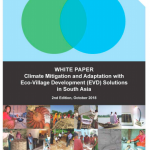
This White Paper “Climate Mitigation and Adaptation with Eco-Village Development (EVD) Solutions in South Asia” analyses and presents climate-effects of EVD solutions, using existing cases from villages in South Asia. EVD combines village-level developmental planning with local sustainable solutions to give villagers climate-resilient supplies of energy, water, agricultural products, and other necessities and […]
Climate Action Network South Asia (CANSA) held its annual general assembly on July 2017 in Nagarkot, Kathmandu. One of the concerns expressed at the meeting was that, while there were plenty of climate change related activities and projects, there was a relative weakness in climate activism – which is the primary driver capable […]